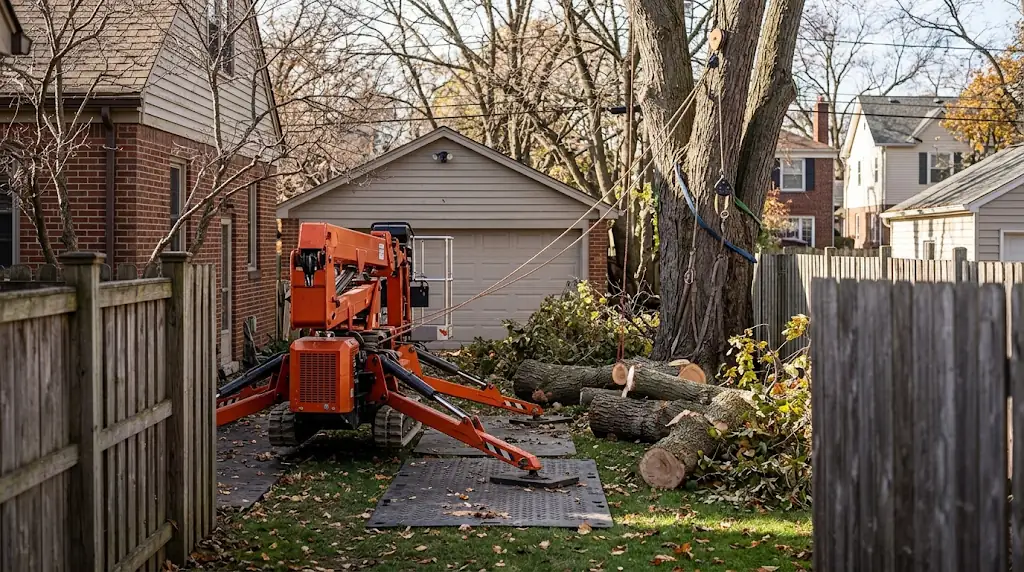
Tree services remove massive trees in tight backyards using mobile hydraulic cranes, compact articulated spider lifts, and precision negative-blocking rigging systems. Instead of dropping large sections to the turf, certified crews pick apart the tree branch-by-branch from overhead and float multi-ton timber over rooflines and landscape beds without setting heavy equipment directly on private lawns.
These low-impact arboricultural methods prevent structural damage to houses, outbuildings, fences, and subterranean utility lines common in dense Oakland County neighborhoods.
Equipment and Rigging Comparison for Tight-Access Removals
Zero-access yards eliminate standard tree-felling approaches. Arborists match the rigging strategy to gate width, lot boundary lines, and tree stability.
| Technique | Machinery Required | Minimum Gate / Access Width | Ideal Yard Scenario | Lawn & Property Impact |
| Crane-Assisted Removal | 45- to 100-ton All-Terrain Crane | 0 inches (Operates from street/driveway) | Enclosed courtyards, zero lot lines, brittle dead trees | Zero backyard turf impact; timber hoisted directly to street chipper. |
| Tracked Spider Lift | Compact Articulated Aerial Lift | 35 to 36 inches | Narrow side gates, rear-lot power lines, soft soils | Minimal; low ground pressure tracks distribute weight over turf mats. |
| Sectional Rigging (Climbing) | Friction Brakes (Port-a-Wrap) & Pulleys | Standard walking path | Healthy trees without crane street setup access | Contained; wood is roped down to a controlled drop zone. |
| Mini Skid Steer Hauling | Articulated Mini Loader (e.g., Ditch Witch) | 36 to 42 inches | Long distances from back fence to front chipper | Controlled; requires composite HDPE ground-protection mats. |
1. Crane-Assisted Removals: Flying Timber Over the Roof
When a 70-foot White Pine or Red Oak grows inside a fully fenced Birmingham courtyard or an established Troy backyard with zero vehicle clearance, bringing heavy machinery through the gate is impossible.
In these scenarios, crane-assisted dismantling is the standard procedure:
- The Street Setup: A 50- to 100-ton all-terrain crane outriggers directly on the paved street or reinforced driveway. Heavy outrigger pads distribute machine weight to avoid cracking concrete or asphalt.
- The Arborist Tie-In: A climber or bucket operator secures the crane’s synthetic winch chokers to a balanced center-of-gravity point on the target limb or trunk spar.
- The Controlled Cut: Once tension is verified by the crane operator, the climber makes a relief and back cut.
- Zero Drop Force: Instead of falling to the turf, the cut branch lifts upward into the air, floats cleanly over the house roof, and lands directly on the street landing zone where ground crews feed it straight into high-capacity wood chippers.
2. Tracked Spider Lifts for Narrow Gates
Historic lots in Birmingham, Clawson, and Royal Oak frequently feature narrow side yards restricted by privacy fences, central air compressors, gas meters, and masonry retaining walls. Bucket trucks cannot enter these spaces.
When trees are too decayed for an arborist to safely climb, crews deploy compact tracked spider lifts:
- 36-Inch Retraction: The rubber tracks hydraulically retract, allowing a machine with 70 to 90 feet of vertical working reach to fit through a standard 36-inch pedestrian backyard gate.
- Low Ground Pressure: Spider lifts run on wide rubber tracks that exert low ground pressure (often under 6 to 8 PSI), minimizing soil compaction across saturated Michigan clay.
- Articulated Booms: Multi-jointed booms articulate over garage peaks, sunrooms, and ornamental garden beds to position the tree surgeon directly alongside hazardous limbs.
3. High-Angle Friction Rigging: Negative Blocking
When overhead power drops or surrounding architecture prevent crane outrigging, climbers dismantle the tree manually using high-angle arboricultural rigging.
Taking down large wood in tight quarters relies on negative blocking:
- Rigging blocks (arborist-rated heavy pulleys) are mounted to the trunk below the cut piece.
- A high-tensile arborist bull rope connects to the wood section and travels down to a friction brake (such as a Port-a-Wrap or friction drum) anchored at the base of the tree.
- As the timber cut is completed, the branch slides off its notch, drops a calculated short distance onto the rope line, and the ground technician dynamic-brakes the load to arrest its momentum before it hits fences, sheds, or manicured flower beds.
4. Protecting Underground Infrastructure in Oakland County
Moving heavy timber across private lawns involves subterranean risks that generic contractors routinely overlook.
Glacial Clay Soils and Deep Rutting
Oakland County soils feature heavy glacial clay that retains moisture long after rainstorms. Rolling heavy logs directly across damp lawns pushes clay particles together, collapsing soil macropores and suffocating the root zones of nearby high-value specimen plants. Crews lay high-density polyethylene (HDPE) ground-protection mats to create temporary roads, dispersing dynamic equipment weight.
Septic Fields, Sprinklers, and Utilities
Tight lots require verifying hidden subsurface hazards before work begins:
- Lawn Irrigation: Private sprinkler heads, manifold boxes, and drip lines must be flagged prior to timber transport.
- Private Septic Systems: In estate-style lots and semi-rural transition zones in Bloomfield Hills and Rochester Hills, septic tanks and drain fields cannot support heavy machinery loads.
- Public Utility Corridors: Removals near secondary service lines require close coordination. While DTE Energy maintains major utility distribution corridors, private residential service lines running between the yard pole and the home’s weatherhead must be cleared by licensed, insured private tree professionals.
Municipal Tree Protection and Right-of-Way Rules
Operating heavy crane machinery and staging timber removal in dense residential neighborhoods requires compliance with local municipal codes:
- City of Birmingham Right-of-Way Rules: The City of Birmingham Department of Public Services retains jurisdiction over all public right-of-way trees and shared boundary plantings. Any crane operation blocking public travel corridors or staging equipment on city streets requires municipal coordination and registration.
- City of Troy Tree Regulations: Under the City of Troy Code Chapter 28, street trees located in the parkway strip between the curb and the sidewalk cannot be pruned, rigged, or cut without a permit issued by the City Director.
Precision Tight-Space Removals in Oakland County
Extracting mature hardwoods from confined suburban backyards requires specialized machinery, technical rigging expertise, and zero-impact ground protection. At Troy Tree Removal, our crews utilize compact 36-inch spider lifts, mobile crane systems, and controlled sectional rigging to remove hazard trees cleanly across Troy, Birmingham, Bloomfield Hills, and all surrounding Oakland County communities.
If you have a difficult-access tree located near your home, fence, or garage, schedule an on-site structural evaluation through our contact page today.