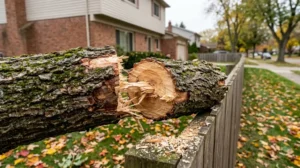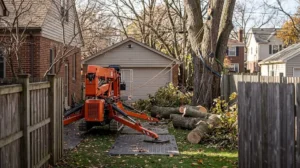
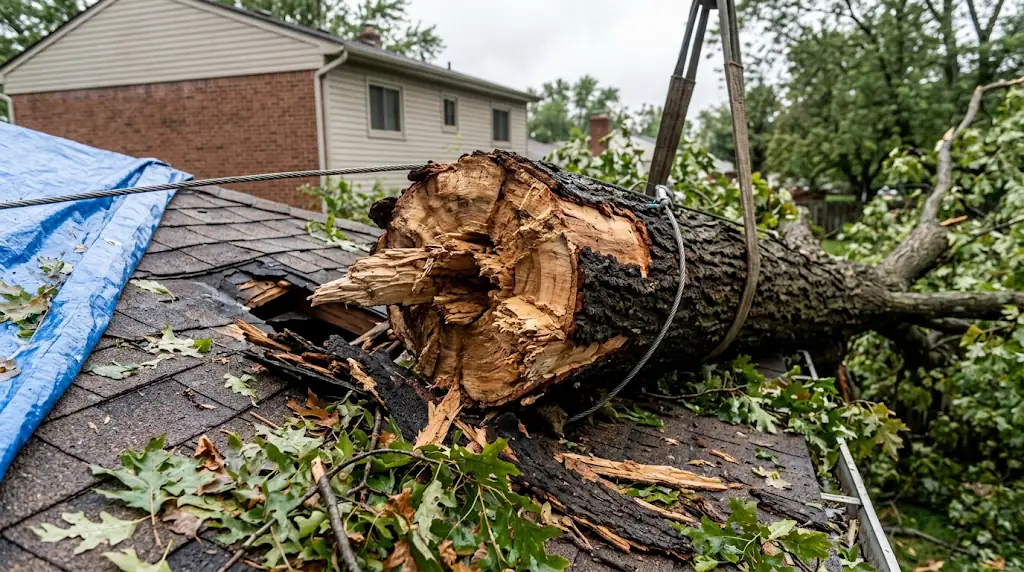
Homeowners insurance covers storm-damaged tree removal in Troy, MI only if the fallen tree damages an insured structure—such as your house, attached garage, shed, or perimeter fence—or completely blocks your driveway. If a tree topples entirely onto your open lawn during a storm without hitting a building or blocking access, insurance covers none of the cleanup costs.
When coverage applies, standard Michigan homeowner policies include specific sub-limits for debris haul-away that operate separately from structural repair payouts.
When Insurance Pays vs. When It Does Not
Insurance carriers look at where the timber landed and what caused the structural failure, not the replacement value of the tree itself.
| Storm Impact Scenario | Insurance Covers Removal? | Applicable Policy Section | Expected Out-of-Pocket Cost |
| Tree crushes roof, siding, or deck | Yes | Dwelling Coverage (Coverage A) + Debris Removal | Policy Deductible only |
| Tree crushes detached shed or fence | Yes | Other Structures (Coverage B) + Debris Removal | Policy Deductible only |
| Tree blocks entire driveway or disability ramp | Yes (Limited) | Additional Coverage: Debris Removal | Capped (typically $500 to $1,000) |
| Tree falls completely on open turfgrass | No | None (Uncovered Event) | 100% of removal and chipping costs |
| Tree falls on personal vehicle in driveway | Yes (Auto Policy) | Comprehensive Auto Insurance (Not Homeowners) | Comprehensive Auto Deductible |
| Pre-existing dead or rotting tree collapses | No (Denied) | None (Excluded under Maintenance/Neglect) | 100% of repairs and removal costs |
The Critical Distinction: Structural Damage vs. Debris Removal Sub-Limits
Homeowners routinely confuse structural repair coverage with tree extraction coverage. Insurance policies separate these into two different financial buckets:
1. Extraction from the Structure
If a 70-foot Red Oak crushes your roof trusses during a severe Oakland County summer windstorm, your carrier covers the crane work and specialized rigging required to lift the heavy trunk off the home under your primary dwelling coverage. This work prevents further structural collapse and water intrusion.
2. Debris Disposal and Haul-Away (The Per-Tree Cap)
Once the tree is safely lifted off the structure and placed on the lawn, the tree is no longer damaging the house. The policy transitions to the “Debris Removal” clause.
Most standard Michigan homeowners policies cap debris removal at $500 to $1,000 per tree, with an aggregate disaster cap of $1,000 to $2,500 per storm occurrence. Because bringing in heavy commercial chippers, skid steers, and dump trailers to cut, load, and haul away a mature multi-ton hardwood often costs $1,500 to $3,500, property owners frequently pay the difference between the actual disposal cost and the policy’s debris sub-limit out of pocket.
The “Act of God” Rule: When a Neighbor’s Tree Crushes Your Property
Severe storm winds off Lake Michigan and localized microbursts routinely fell trees across boundary lines in mature neighborhoods like Troy, Bloomfield Hills, and Rochester Hills.
If your neighbor’s living tree uproots during a severe storm and crashes onto your roof, garage, or fence, you file the claim with your own homeowners insurance company.
Under Michigan law, severe weather is classified as an “Act of God” (force majeure). The neighboring property owner carries zero legal liability for natural storm failures. Your own policy covers the damage to your dwelling and secondary structures, and you remain responsible for paying your policy’s deductible.
The Single Exception: Documented Negligence
Your neighbor (and their insurer) is financially responsible only if you can prove their negligence caused the failure. Negligence requires proving:
- The tree possessed obvious physical rot, dead canopy sections, hollow trunks, or fungal conks prior to the storm.
- The owner had actual knowledge of the hazard.
- You sent written notification (such as a certified letter enclosing an arborist assessment) warning them of the hazard before the storm hit.
In proven negligence cases, your insurance carrier will pay your structural repairs and subsequently file a subrogation claim against the neighbor’s insurer to recover your deductible.
Why Insurance Carriers Deny Storm Claims
Insurance policies cover sudden, accidental physical perils. They strictly exclude gradual decay, insect infestations, and deferred property maintenance.
Adjusters inspect fallen trees for signs of pre-existing failure:
- Emerald Ash Borer Decay: Thousands of green and white ash trees across Southeast Michigan have stood dead for years. If a brittle, bark-stripped ash tree breaks during a 40 mph gust, adjusters routinely deny the claim due to owner neglect.
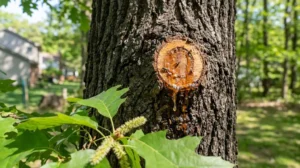
- Internal Heartwood Rot: Large trunks hollowed out by carpenter ants or bracket fungi (Ganoderma) that fail without showing major external storm breakage may be deemed long-term structural failure rather than storm damage.
- Lack of Maintenance History: Failing to prune dead hanging limbs (widowmakers) over rooflines transfers liability back to the homeowner.
Step-by-Step Claim Protocol After Storm Damage
To ensure an insurance claim is processed and reimbursed without carrier disputes, execute these steps immediately following a storm:
- Document Before Altering: Take wide, date-stamped photographs and video of the entire tree, the impact points, structural damage, and the trunk base showing root health. Do not move branches until photographic proof is secured.
- Mitigate Further Harm: Under Michigan standard policy contracts, homeowners must prevent secondary losses. Tarp open roof punctures or broken skylights immediately. Tree services bill this under emergency storm mitigation.
- Notify the Insurer: File the claim immediately to establish a date-of-loss file. Inform the adjuster that emergency tree stabilization is required.
- Obtain an Itemized Tree Invoice: Insurers reject vague invoices that read “Storm Cleanup: $3,500.” Request a line-item estimate that separates:
- Crane mobilization and emergency extraction off the dwelling.
- Tarping and emergency roof board-up.
- Cutting and sectioning the tree on the ground.
- Debris haul-away and disposal fees.
- Exclude Stump Grinding: Insurance policies do not cover stump grinding. Grinding an in-ground stump is classified as cosmetic landscaping improvement, not structural debris cleanup.
Public Right-of-Way Trees in Troy
If a storm knocks down a street tree located between the roadway curb and the public pedestrian sidewalk, municipal regulations take effect.
Under the City of Troy Code Chapter 28, trees planted within the municipal right-of-way are managed under city authority. If a city tree falls onto your private driveway or lawn, contact the Troy Department of Public Works to clear the primary right-of-way blockage before hiring private crews.
Rapid Emergency Storm Response in Troy
Navigating storm damage requires certified tree rigging crews who understand how to extract multi-ton loads off roofs without causing secondary structural punctures. At Troy Tree Removal, our teams provide rapid emergency crane removal, storm cleanup, and detailed, adjuster-ready itemized billing across Troy, Birmingham, Rochester Hills, and surrounding Oakland County communities.
If a storm has damaged a tree on your home, garage, or driveway, schedule immediate service through our contact page today.