No, homeowners in Troy, MI do not need a municipal permit to remove an ordinary tree located entirely on private residential property. However, you must obtain a city permit or explicit municipal clearance if the tree sits within a public right-of-way, encroaches on a designated wetland or conservation easement, or is part of a commercial property undergoing site plan review.
Understanding exact boundary lines and municipal ordinances prevents expensive property line disputes and municipal code citations across Oakland County.
When a Tree Removal Permit Is Required in Troy
While private residential backyards remain largely exempt, specific situations trigger city oversight, formal permit applications, or mandatory arborist reviews.
| Scenario | Permit Required? | Governing Authority | Key Conditions & Thresholds |
| Private Backyard / Front Yard (Interior Lot) | No | None (Homeowner Discretion) | Tree must sit completely within private property boundary lines. |
| Street Tree / Planting Strip (Curb to Sidewalk) | Yes | City of Troy Department of Public Works | Mandatory permit under city municipal tree regulations before cutting or pruning. |
| County Road Right-of-Way (e.g., Adams, Big Beaver) | Yes | Road Commission for Oakland County (RCOC) | Encroachments along county-maintained thoroughfares require RCOC review. |
| Protected Wetlands & Conservation Easements | Yes | Michigan EGLE & City Planning Commission | Regulated environmental zones prohibit unpermitted clearing or soil disturbance. |
| New Construction / Major Lot Redevelopment | Yes | Troy Planning & Zoning Department | Site plan approvals require a formal Tree Identification Survey for trees 4″ DBH and larger. |
The Public Right-of-Way Rule: The “Tree Lawn” Misconception
The most common municipal violation in Troy occurs in the “tree lawn”—the strip of grass situated between the paved street curb and the public pedestrian sidewalk.
Even though homeowners are legally responsible for mowing and maintaining this turf, that strip is public land. Under the City of Troy Code Chapter 28 (Tree Regulations), no individual or contractor may prune, treat, or remove any woody plant or tree within a public street, parkway, or municipal right-of-way without obtaining a written permit issued by the city director.
Cutting down a municipal street tree without authorization results in misdemeanor citations, replacement tree mandates, and civil infraction fines payable to the City of Troy.
Municipal Mandates for Dead and Diseased Trees
Private property ownership does not give owners complete immunity from municipal action if a tree endangers the public or adjoining properties.
Under Chapter 28, Section 5 of the Troy municipal code, private landowners carry a legal affirmative duty to treat or eliminate hazards:
- Public Hazard Abatement: Property owners must remove or prune any tree or limb that blocks clear line-of-sight at traffic intersections, obstructs street signs, or hangs lower than municipal street clearances.
- Contagious Pathogens: Private owners are required to treat or cut down trees infested with severe pathogens or pests that threaten the broader public canopy.
- City Removal Orders: If an arborist inspection determines a private tree is hazardous to a public space, the city issues a formal notice to remove it. Failure to complete removal allows the city to send municipal contractors and bill the property owner directly via property tax assessments.
How Neighboring Oakland County Cities Compare
Tree preservation policies vary widely across neighboring Southeast Michigan communities. Working across municipal lines requires checking local ordinances:
- Troy: No private residential removal permits for established single-family homes outside easements and right-of-ways.
- Rochester Hills: Strict environmental protection over designated natural features, steep slopes, and wetlands. Residential parcels inside regulated woodland boundaries require woodland permits before taking down protected canopy trees.
- Birmingham & Bloomfield Hills: Enforce rigorous historic canopy protections and strict building envelope reviews. Removing landmark hardwoods during landscape alterations often requires arborist reviews and compensatory replacement trees.
- Royal Oak, Clawson & Madison Heights: High urban density. Street-tree ordinances parallel Troy’s Chapter 28, but narrow lot lines trigger heightened review when felling near neighboring overhead utility infrastructure.
Property Lines and the “Boundary Tree” Rule in Michigan
A tree whose trunk sits directly on the boundary line between two properties belongs to both homeowners as tenants in common under Michigan common law.
- Mutual Consent Required: Neither neighbor may legally cut down, girdle, or fatally compromise a boundary tree without the explicit written agreement of the other owner.
- The Self-Help Rule: You possess the legal right to trim overhanging branches or encroaching roots that cross your boundary line up to the property plane.
- The Vital Limit: You cannot trim beyond the property line, trespass onto your neighbor’s land without permission, or prune the branches so aggressively that the tree dies. Doing so exposes the trimming party to statutory treble damages (triple the tree’s replacement value) under Michigan timber trespass law.
Always locate survey boundary pins or review an official mortgage property survey before bringing in a tree crew.
Power Line Clearance: Private Lines vs. DTE Infrastructure
Never hire a standard uninsured handyman to fell trees near electrical corridors.
- Distribution Lines (Pole-to-Pole): DTE Energy maintains scheduled preventative pruning circuits along major municipal alleys and utility corridors.
- Service Drops (Pole-to-House): The single overhead line supplying electricity to your residential meter is the property owner’s responsibility.
When a hazardous tree threatens your primary service drop, contact your electric utility to temporarily drop and disconnect the secondary wire on the morning of removal. Reputable tree services coordinate directly with utility dispatchers to ensure lines are re-energized immediately after the tree safely hits the ground.
Seasonal Restrictions: Michigan Oak Wilt Rules
While Troy does not require a formal permit to take down an oak tree on your personal lawn, biological regulations govern safe removal windows.
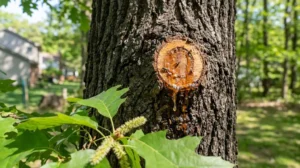
The Michigan State University Extension warns that oak trees should not be pruned or mechanically injured between April 15 and July 15. Nitidulid sap beetles actively fly during these warm months, carrying Bretziella fagacearum spores directly to open tree wounds and killing healthy mature red oaks within six weeks.
If an oak sustains structural storm breakage during this prohibited window, cuts must immediately be sealed with tree paint or latex paint to stop beetles from feeding.
Safe, Compliant Tree Removal in Troy
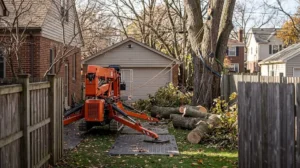
Navigating municipal right-of-ways, utility clearances, and Michigan boundary rules requires professional arborist oversight. At Troy Tree Removal, we identify public right-of-way boundaries, coordinate directly with utility line crews, and execute clean, compliant tree removals across Troy, Birmingham, Bloomfield Hills, and all surrounding Oakland County communities.
To confirm boundary requirements or receive an upfront estimate for your property, connect with our crew through our contact page today.