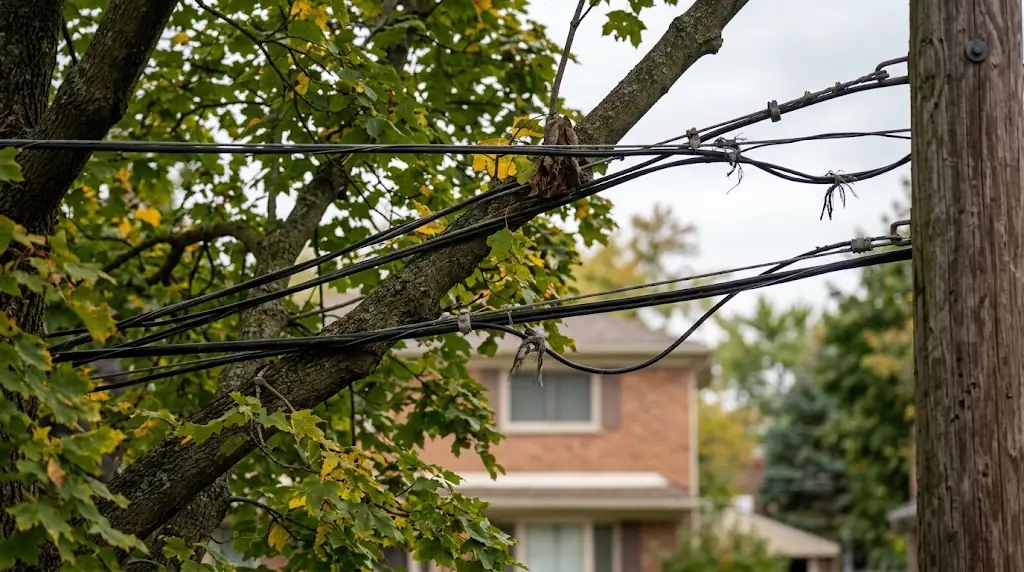
DTE Energy clears trees and overgrown branches around primary pole-to-pole distribution lines, but the homeowner is strictly responsible for trimming or removing trees near the secondary service drop running from the pole to the house. If a tree threatens the electric line directly feeding your residential meter, DTE will not cut it down; you must hire a qualified private tree care company to clear the line.
Understanding this division of responsibility prevents unexpected power outages, structural electrical fire risks, and code violations across Oakland County.
DTE Responsibility vs. Homeowner Responsibility
The utility boundary line between utility-maintained infrastructure and private property equipment is clearly defined by Michigan utility standards.
| Electrical Component | Location | Responsible Party | Maintenance Details |
| High-Voltage Distribution Lines | Pole-to-pole (along streets and utility easements) | DTE Energy | Routinely trimmed on scheduled multi-year cycles to maintain a ~15-foot safety corridor. |
| Secondary Service Drop | Pole-to-house (overhead line to your electric meter) | Homeowner | Homeowner must hire an insured private tree service to clear encroaching branches. |
| Meter Base & Weatherhead | Exterior wall of residential home | Homeowner | Private homeowner property; homeowners pay for electric repairs if pulled from the siding. |
| Telecommunication / Cable Drops | Pole-to-house (lower wires: Comcast, AT&T, WOW!) | Homeowner | Telecommunications companies and DTE do not trim brush off communication lines. |
| Downed Active Lines (Emergency) | Anywhere on property ground | DTE Energy | Call 911 and DTE immediately; emergency utility crews de-energize and clear lines. |
DTE’s Preventative Tree Trimming Program
DTE operates regular preventative maintenance circuits to protect broader neighborhood grids across Troy, Rochester Hills, and Birmingham. According to official guidelines from DTE Energy, utility clearance crews prune vegetation around pole-to-pole infrastructure:
- Clearance Radius: DTE contractors trim an approximate 15-foot radius around primary high-voltage electrical wires to prevent contact during heavy wind and ice loads.
- Hazard Tree Removal: DTE removes dead, structurally compromised, or heavily leaning trees that sit within the utility easement and threaten primary lines.
- Debris Clean-Up Policy: DTE crews chip and haul small branches and brush resulting directly from their scheduled maintenance. However, large wood rounds are cut into firewood lengths and left on-site for the homeowner. Crucially, DTE does not remove trees or limbs that fall naturally due to storms or pre-existing decay.
If DTE marks a tree on your property for scheduled line clearance, you will typically receive an advance door-hanger notice detailing planned trimming along the utility easement.
The Service Drop: Why Homeowners Must Clear Their Own Line
The overhead line connecting the nearest utility pole to the weatherhead on the corner of your roof or exterior wall is your personal service connection.
DTE does not clear branches touching or encroaching on private service drops because these lines carry low-voltage electricity (120/240 volts) dedicated exclusively to your dwelling. An outage on this wire affects only your household, not the broader grid.
Leaving branches resting on your service drop creates severe hazards:
- Mechanical Abrasion: Constant wind movement rubs rough tree bark against the protective insulated jacket, exposing bare aluminum conductors and causing short-circuit arc fires.
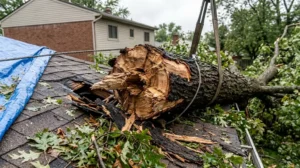
- Structural Tearing: Heavy storm branches falling onto the service drop can rip the mast pipe and meter box clean off your home’s exterior siding, causing thousands of dollars in electrical repairs that homeowners must pay out of pocket before DTE will restore service.
- Tensile Strain: Snow accumulation and ice storms weigh down overhanging pine or oak limbs, putting extreme physical tension on utility poles and residential eaves.
How to Safely Remove a Tree Near an Overhead Service Line
Never attempt to prune, chainsaw, or pull down branches touching an overhead electrical line yourself. Live trees conduct electricity, and wood ladders or wet ropes can channel lethal voltage to ground level.
Follow this standard procedure when removing trees near energized drops:
- Schedule a Temporary Disconnect: Contact DTE customer operations in advance of your scheduled tree work to request a temporary service disconnection. DTE will unhook your overhead service drop at the pole on the morning of your project.
- Execute Precision Felling: With the drop de-energized or laid safely on the ground, certified tree crews rig down heavy trunk sections and limb canopies without risking wire contact.
- Re-Energize Service: Once the timber is safely lowered and moved away from the wire path, the utility lineman returns to reattach the line, restoring power to your panel.
Municipal Right-of-Ways and Street Tree Rules
In established subdivisions across Troy, Clawson, and Royal Oak, utility lines often travel along front curbs or within designated municipal street easements.
- Street Trees: If the tree growing into the electrical lines is located within the planting strip between the street curb and the sidewalk, it is governed by the City of Troy Code Chapter 28. Private residents are prohibited from cutting down municipal right-of-way trees without an authorized permit from the City Director.
- Rear-Lot Easements: In older neighborhoods without front poles, electrical lines run through rear-lot utility corridors. Homeowners must provide utility crews and licensed tree specialists unobstructed access to back fences to service lines safely.
Plant the “Right Tree, Right Place” Near Utility Corridors
Future line clearance issues can be prevented entirely with proper species selection. When replanting in front yards or directly beneath utility corridors, follow municipal and utility height recommendations:
- Directly Under Power Lines (Max Mature Height: 20 Feet): Plant small ornamental specimens such as Eastern Redbud, Japanese Tree Lilac, Serviceberry, or Flowering Dogwood.
- 20 to 50 Feet from Power Lines (Max Mature Height: 40 Feet): Plant medium-profile species like Hornbeam, Crabapple, or River Birch.
- More Than 50 Feet from Power Lines (No Restriction): Reserve large-canopy hardwoods such as Red Oak, Sugar Maple, and Tulip Poplar for wide-open backyards where mature crowns will never touch utility easements.
Safe, Insured Tree Clearance in Troy
Taking down large hardwoods or pruning heavy overhanging limbs near electrical lines requires specialized rigging, aerial bucket access, and experienced line-clearance practices. At Troy Tree Removal, our crews safely manage difficult drop zones, protect residential weatherheads, and execute zero-impact removals across Troy, Birmingham, Bloomfield Hills, and all surrounding Oakland County neighborhoods.
If an overhanging tree or hazardous dead branch is threatening your overhead service line, reach out through our contact page to arrange an on-site safety assessment.