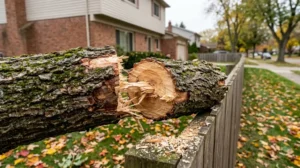
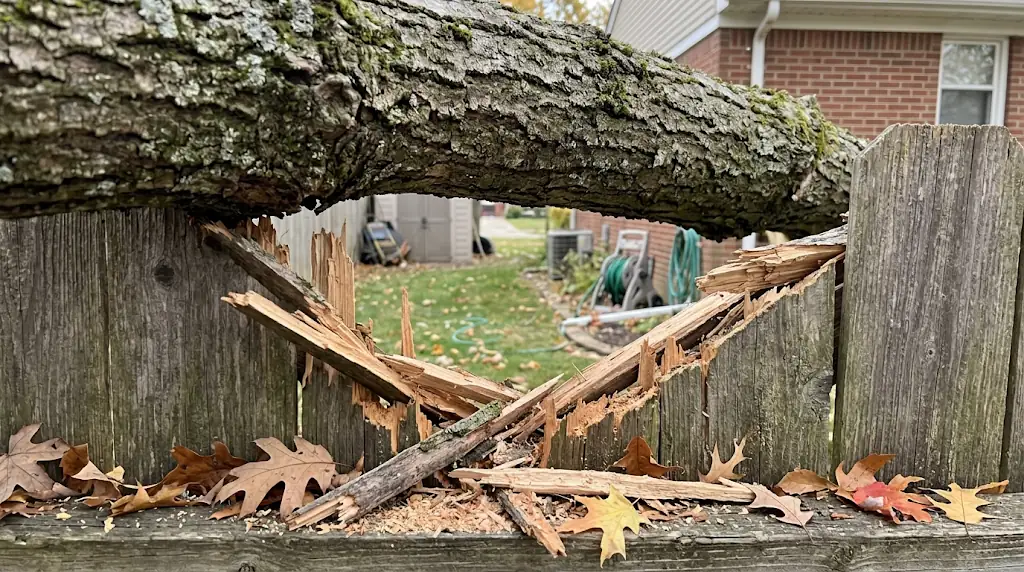
Under Michigan law, you and your homeowners insurance pay for damage caused to your property by a neighbor’s fallen tree, provided the tree fell due to natural weather events. The neighbor is only financially liable if you can prove their negligence—meaning the tree was visibly dead, rotted, or structurally compromised, and the owner ignored documented warnings before it collapsed.
Where the trunk was rooted does not determine insurance payouts; where the damage lands dictates who pays.
Liability Matrix: Acts of God vs. Proven Negligence
Michigan courts separate fallen tree liability into two clear categories: natural weather occurrences and owner negligence.
| Failure Scenario | Primary Payer | Insurance Policy Used | Responsible for Deductible? | Legal Grounding in Michigan |
| Healthy tree topples in severe wind/ice storm | You (Affected Property Owner) | Your Homeowners Policy | Yes (You pay your deductible) | “Act of God” doctrine; no owner fault. |
| Visibly dead/decayed tree falls after written notice | Neighbor (Tree Owner) | Neighbor’s Liability Coverage | Yes (Neighbor pays or reimburses) | Common-law negligence; failure to eliminate a known hazard. |
| Tree falls onto your parked vehicle in driveway | Your Auto Insurance | Your Comprehensive Auto Policy | Yes (You pay comprehensive deductible) | Michigan No-Fault Insurance framework. |
| Tree falls entirely on lawn without hitting structures | You (Affected Property Owner) | Out-of-pocket (Insurance rarely pays) | Full cleanup cost | Debris removal without structural damage is typically excluded. |
| Shared boundary tree (trunk straddles property line) | Shared Responsibility | Both policies or split cash cost | Split evenly | Boundary trees are held in common tenancy. |
The “Act of God” Rule in Southeast Michigan
High winds off the Great Lakes, severe summer convective storms, and winter ice storms regularly topple mature canopies across Troy, Rochester Hills, and Bloomfield Hills.
When severe weather causes a living, structurally intact hardwood to uproot or snap, Michigan law classifies the event as an “Act of God” (force majeure). Because natural phenomena are beyond human control, the tree owner carries zero legal liability for the damage.
Insurance attaches to the damaged structure, not the fallen object. If your neighbor’s 60-foot oak crushes your roof or perimeter fence, you must file the claim with your own insurance carrier, pay your policy deductible, and let your insurer cover the structural repairs and emergency limb extraction.
When the Neighbor Is Liable: Establishing Negligence
A property owner is legally and financially responsible only when their failure to maintain their tree constitutes negligence.
To hold a neighbor liable in Oakland County, you must prove three distinct elements:
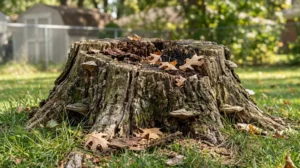
- Clear Physical Defect: The tree had obvious signs of structural compromise, such as severe trunk rot, fungal conks (bracket mushrooms), deep vertical frost cracks, major deadwood canopies, or severe lean caused by root decay.
- Prior Notice (Constructive or Actual Knowledge): The owner knew—or reasonably should have known—that the tree presented an imminent hazard to adjacent properties.
- Failure to Act: The owner took no reasonable action to mitigate the hazard through professional pruning, cabling, or removal.
If negligence is proven, your insurer will pursue subrogation against the neighbor’s liability carrier to recover your deductible and repair costs.
How to Legally Document a Hazardous Neighbor Tree
Verbal conversations over the back fence do not hold up in insurance subrogation disputes or small claims court. If a neighbor’s tree threatens your house, garage, or driveway, follow this exact verification process:
- Hire an ISA Certified Arborist: Pay for a documented Tree Risk Assessment (TRAQ). The written report provides third-party confirmation of structural hazards, fungal decay, or root system failure.
- Photograph Visible Indicators: Take clear photos showing dead branches, hollow cavities, carpenter ant frass, or soil heave at the base of the trunk.
- Send a Certified Letter with Return Receipt: Mail a formal, polite notice containing copies of the photos and the arborist’s findings. Request that they inspect and remediate the hazard.
- Retain the USPS Signature Card: The return receipt provides legal evidence that the owner received actual notice, dismantling any future “Act of God” defense if the tree falls.
Overhanging Limbs: The Michigan Self-Help Rule
You do not have to wait for an encroaching branch to break and damage your property.
Under Michigan common law, property owners hold the right of “self-help.” You may cut away any encroaching branches, limbs, or underground roots that cross into your airspace or soil, up to the vertical property boundary line.
However, strict limitations apply under Michigan law:
- The Vertical Boundary Limit: You cannot step across the boundary line or trim wood situated on the neighbor’s side of the property line without explicit permission.
- Timber Trespass Protections: Under Michigan Compiled Laws Section 600.2919 (MCL 600.2919), anyone who cuts down, despoils, or fatally injures a tree on another’s land without permission can be held liable for statutory treble damages (three times the actual replacement value of the tree).
- Structural Preservation: Pruning so aggressively that you destabilize the root plate or kill the tree exposes you to severe financial liability under MCL 600.2919. Pruning should always follow ANSI A300 standards.
Municipal Codes Across Troy, Birmingham, and Royal Oak
In dense Oakland County neighborhoods like Clawson, Royal Oak, and older subdivisions of Troy, boundary issues intersect with municipal safety enforcement:
- Intersection Sightlines: Under the City of Troy Code Chapter 28, limbs hanging below municipal roadway clearances or obstructing driver vision must be trimmed by the tree owner. Failure to do so results in municipal code citations.
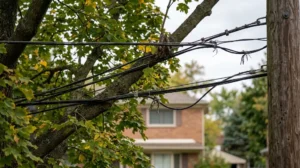
- Public Utility Corridors: When a private hazard tree threatens municipal power lines, DTE Energy prunes primary utility paths, but secondary service drops running directly to individual houses remain the homeowner’s responsibility to clear safely with a qualified contractor.
Protect Your Property with Professional Hazard Assessments
Resolving boundary tree issues requires accurate boundary verification, tree health documentation, and precision rigging to protect adjoining properties. At Troy Tree Removal, our crews specialize in hazard identification, zero-impact removals, and proactive clearance pruning across Troy, Birmingham, Rochester Hills, and surrounding Oakland County communities.
If an overhanging or decaying tree threatens your home or garage, schedule an on-site property evaluation through our contact page today.